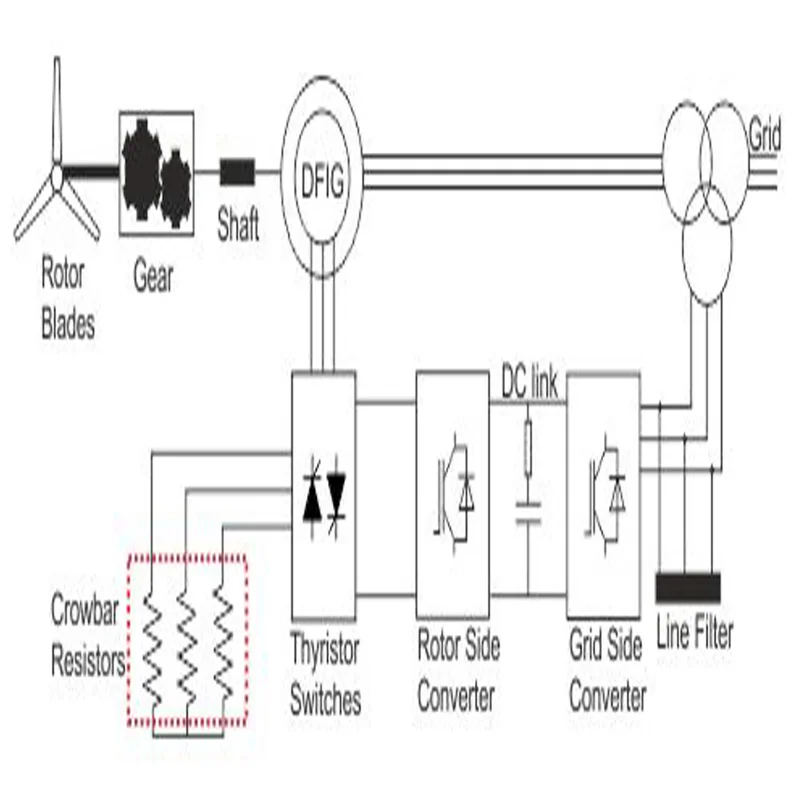
When there is a grid failure, the response time that a wind turbine converter can give is practically negligible. The rotor continues to push power into the system, and within milliseconds, the voltage of the DC link rises to dangerous levels, and expensive semiconductors become vulnerable. The solution is the insertion of a resistor for a very brief moment to absorb the excess power as heat, after which it will move out of the way. This is where the crowbar resistors manufacturer comes into play.
Three factors define our scope of application: how much energy needs to be absorbed, how frequently, and where the unit will reside.
Short-duty designs are suitable for one-time impact loads such as ride-throughs that last but an instant, employing compact stainless steel and nichrome grids. Repetitive-duty designs come with higher thermal capacity and greater cooling systems due to the potential for repetitive activation by a converter. Outdoor-duty models provide weather protection for nacelles, boxes, and roofs.
The vast majority of our crowbar resistor inquiries relate to the above two categories. All of our crowbar resistors are custom-made according to their duty first. Any wise crowbar resistors manufacturer will pose these questions before quoting.
The resistor has five properties, which are explained in the table below.
| Value | What it controls |
|---|---|
| Energy | Total kJ absorbed per event, which sets resistor mass |
| Peak power | Highest instantaneous kW, which sets element and current path size |
| Duration | How long the resistor stays connected, from milliseconds to seconds |
| Voltage | DC link level and insulation class |
| Cooling | Natural air, forced air, or liquid |
Energy comes first because, in case the converter needs to dissipate 500 kW for 2 seconds, the resistor dissipates 1,000 kJ, and the energy doubles even if the peak power does not change when the time is doubled. This explains why a crowbar resistor of a wind turbine is sized according to the total fault profile and not only the peak power. The crowbar resistor is tested against the total fault profile, and a good crowbar resistors manufacturer will ask you about your rest period between events.
Protection is the first advantage. Controlling the DC link voltage ensures that semiconductors operate within their range, thereby avoiding the risk of replacement and associated downtime. Secondly, there is compliance, where the grid code requires turbines to withstand low-voltage situations, and the appropriately sized crowbar resistor helps in riding through voltage dips.
Thirdly, there is simplicity since the resistor is passive, meaning that not much can go wrong and a wind turbine crowbar resistor with replaceable elements will be easier to maintain in situ. Crowbar resistors manufacturers provide these advantages in datasheets.
A classic example is wind turbines. In a doubly-fed induction generator, a voltage sag causes high currents to flow into the rotor circuit, where the crowbar serves as protection for the rotor-side converter. The crowbar resistor in the nacelle or at the base of the tower will need to withstand vibration, dust, and temperature variations.
Variable speed drives face a unique challenge. In the event that a large motor decelerates rapidly or a crane lowers a load, the energy is returned to the DC bus. The crowbar resistor is activated, dissipates the energy, and protects against overvoltage.
There is a common design principle that holds true for all kinds of converters from solar inverters to UPS systems. A crowbar resistor manufacturer should be able to explain how the resistor reacts during the initial milliseconds, not just at equilibrium conditions.
Since each converter has its own limitations, we tailor our resistor to suit it. You may specify:
In the case of wind turbine crowbar resistors, we have to meet additional limitations concerning nacelle size and weight. Just provide us with your converter specifications, and our team from the crowbar resistors manufacturer will provide you with a drawing.
Take an example of one component and see how it passes through our testing procedures. After measuring the resistance of that component against the designed value, we measure the insulation resistance and then test it with a dielectric withstand test on the terminals and enclosure. This is followed by a heat run in which the rated power is passed through it and the temperature rise is measured.
Crowbar resistors adhere to IEC standards and standards of various countries. Records are maintained for each order. Wind turbine crowbar resistors for an important project can be seen by your inspector and a good crowbar resistors manufacturer will not mind that.
Manufacturing, construction, wiring, and testing all occur in one place, guaranteeing consistency of quality and realistic shipping times. The engineers that you will be dealing with will make sure to let you know without any sugarcoating whether or not a smaller device is suitable. A crowbar resistors manufacturer must also stick around even after the transaction, which is why we are keen on conducting commissions and supplying spare parts. We have produced the wind turbine crowbar resistor and other classes of duty many times, and we know what mistakes people tend to make in their design process. Let us know your converter specifications and fault profile and we will get back to you with an estimate.
Switch a resistor across the DC link as soon as voltage rises, and size it for the full fault energy. Your crowbar resistors manufacturer can help you check the trigger level.
Multiply the power to be dumped by the time it flows, then add a margin. A crowbar resistor manufacturer can refine this from your fault profile.
That depends on the duty rating and cooling, since heat must leave between events. Ask the crowbar resistors manufacturer for a rest-time figure.
Most units use natural or forced air, while liquid cooling suits compact, high-energy duty. A crowbar resistors manufacturer will recommend one after seeing your duty cycle.
Please share energy, peak power, duration, voltage, cooling preference, and enclosure type. With these, a crowbar resistors manufacturer can quote quickly.