Single-line-to-ground fault is the most typical fault in a medium voltage network and the majority of them are usually transient. The branch touches the conductor, the bird causes discharge across the air gap or the insulator discharges in wet weather. In a conventional system, each of these situations triggers the breaker, causing the disruption of power supply. With an arc suppression coil, this will not happen as the arc will extinguish by itself. This explains how it works, what should be specified and what to expect from the manufacturer.
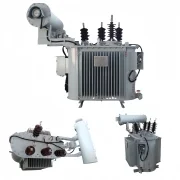
The turn-adjustable arc suppression coil is a single-phase reactor with a tapped winding. By changing the number of active turns in the winding, it is possible to change the inductance and, hence, adjust the coil in accordance with the capacitance of your network. It is called the Petersen coil after Waldemar Petersen, who invented it.
We provide two types. The first one involves de-energised tap changing that is applicable to a stable network whose structure hardly changes. The second one involves motorised tap changing that is on-load and controlled automatically and is applicable to developing networks. All Petersen coils used are immersed in oil and have a linear magnetic characteristic.
There are four main parameters of the design:
| Parameter | What it means for your network |
|---|---|
| Voltage | System voltage, usually 6 to 35 kV, that dictates the rated phase voltage for the coil |
| Capacitive current range | Earth-fault current generated by the network, which the coil needs to balance out |
| Tuning range | Range of currents covered so that one coil will be sufficient for current networks and future additions |
| Controller | Device that measures the neutral displacement voltage and controls the tap changer |
Share our values and we shall design your turn-adjustable arc suppression coil to allow future growth. In addition, the controller also logs all fault incidents that enable the maintenance crew to assess the performance of the power grid. A well-tuned Petersen coil ensures there is very little residual current at the point of fault.
The main advantage of arc suppression is supply continuity. When you have the arc suppression coil connected to the neutral circuit, the induced inductance in the coil will counteract the capacitive current from the fault and what remains is insignificant and incapable of maintaining the arc, hence self-clearing of temporary faults without a trip.
Other advantages include reduced step and touch voltages, less damage to cables and insulators, reduction of reclosures at switchgear, minimal maintenance for the reactor and automatic tuning for turn-adjustable arc suppression coils due to line switching and feeder additions.
A coil can’t operate in isolation. The coil requires a neutral connection, a tuning mechanism, and protection from resonance effects; hence, the complete package is made available through engineering.
Let’s first discuss the neutral. If the main transformer has a star point, the coil will be connected to this point. On the other hand, if the system is delta-connected, the zigzag grounding transformer provides the neutral point. Then the controller tunes the system depending on changing conditions. The last one is the damping resistor, which prevents the displacement of the neutral voltage at resonance. In some designs, there’s an additional switch resistor to increase the fault current temporarily for better relay operation.
The ordering of the arc suppression coil and its accessories together prevents a rating mismatch. All Petersen coil kits include the terminations already connected.
Overhead network: Rural and semi-urban networks experience the greatest number of temporary faults due to lightning, wind, vegetation, and birds. The arc suppression coil is suitable for such networks, as most arcs extinguish and feeding is resumed without interruptions.
Cable network: Cables have significant capacitance, and earth fault current is high. A turn-adjustable arc suppression coil compensates for this and provides cable insulation. Faults on cables are usually permanent and therefore the protection system should be able to detect and isolate them.
This applies to mixed networks, industrial plants, mines, and renewable collector networks as well. In each case, the Petersen coil helps reduce unexpected interruptions and improve reliability indexes.
We conduct pre-delivery tests for all coils, which include resistance winding test, voltage ratio test, insulation resistance test, and dielectric withstand test. Linearity is tested at various tapping settings while proving the controller using simulated neutral voltages. On site, we determine the capacitance of the network, tune the system, and determine damping. We also conduct training for your personnel. It is important to note that the effectiveness of a turn-adjustable arc suppression coil depends on its configuration, which is why we remain involved until everything is working as expected.
We design, wind, assemble and test our coils. The components being designed, wound, assembled and tested as one unit are sure to perform well together. We also give you honest advice on other types of grounding systems whenever needed. You get engineering expertise right from enquiry through commissioning, plus documentation. We will come up with a turn-adjustable arc suppression coil that works for your network if you supply us with your network information.
Connect an arc suppression coil to the neutral of your network. It cancels the capacitive fault current, so most temporary faults extinguish by themselves and breakers stay closed.
Adding feeders raises the capacitive current. The controller measures the change and moves the taps to restore resonance. On manual versions, an operator selects the tap while the coil is de-energised.
A mistuned coil leaves a larger residual current, so arcs may not clear. Tuning very close to resonance raises neutral voltage, which is why the damping resistor and controller matter.
In most cases, yes. A damping resistor limits neutral voltage near resonance, and a switched resistor can help protection find the faulted feeder.
Please share the system voltage, frequency, capacitive earth-fault current, expected growth, and neutral availability. Also tell us your protection scheme and site conditions, so we can size the right arc suppression coil.