
03 Sep, 2026
Two devices with different jobs
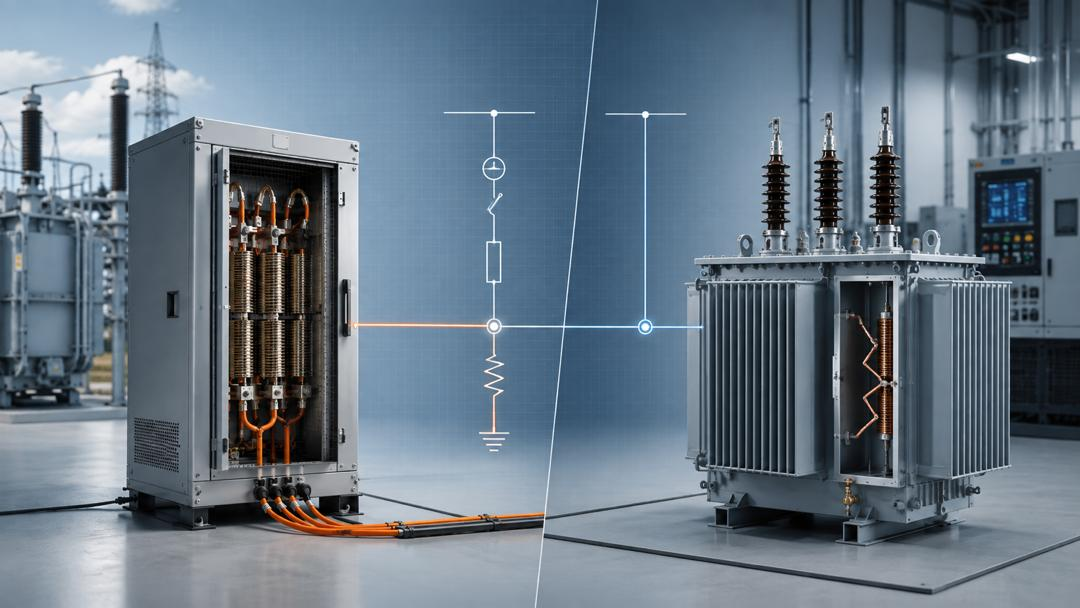
A neutral grounding resistor and a grounding transformer are often discussed together, but they do not perform the same function. The NGR limits the magnitude of ground-fault current. A grounding transformer creates an accessible neutral point on a three-phase system that otherwise has no neutral available for grounding.
In many installations the two devices are used together: the grounding transformer establishes the neutral, and the resistor connects that neutral to earth while controlling fault current.
What does a neutral grounding resistor do?
An NGR is connected between an existing transformer or generator neutral and ground. During normal balanced operation, very little current flows through it. During a single-line-to-ground fault, the resistor limits current to a predetermined value. This reduces thermal and mechanical damage and allows the protection system to detect the fault in a controlled manner.
An NGR can only be connected directly when a suitable neutral terminal is available and when the source design permits that connection.
What does a grounding transformer do?
A grounding transformer, also called an earthing transformer, provides a neutral reference for an ungrounded delta-connected system or another system without an accessible neutral. Zigzag and wye-delta arrangements are widely used. Under balanced conditions, the transformer carries little load apart from losses and any auxiliary burden. During a ground fault, it provides a zero-sequence current path for the grounding and protection system.
A grounding transformer does not automatically limit current to the desired value. Depending on the system design, an NGR or reactor is connected to its neutral to establish the required ground-fault current.
When is an NGR alone sufficient?
An NGR may be sufficient when the power transformer or generator already provides an accessible neutral with the necessary insulation and current capability. The neutral connection, protection coordination and source manufacturer’s limitations should all be checked before final selection.
When is a grounding transformer required?
A grounding transformer is generally considered when the bus is delta-connected, when no usable neutral is available, or when a separate grounding source is needed for a section of the network. The grounding transformer must be rated for the expected neutral current and duration, and its impedance must be included in the ground-fault study.
Key selection questions
Before choosing equipment, confirm whether the system has an accessible neutral; the line-to-line voltage and frequency; the required ground-fault current and duration; the system capacitance-to-ground; the relay and tripping philosophy; the auxiliary load, if any; and the indoor or outdoor installation conditions.
Electric Valley can coordinate neutral grounding resistors, grounding transformers and associated cabinets as a project package. Supplying the single-line diagram and fault-study data helps the engineering team identify the appropriate arrangement without over- or under-specifying the equipment.