10 Nov, 2026
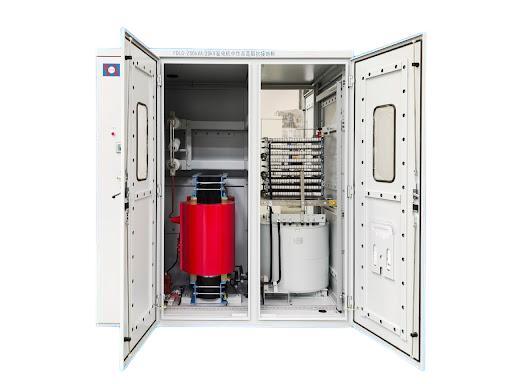
An Arc Suppression Coil is a reactor wired into the neutral point of a medium-voltage network. When one phase touches ground, the coil supplies an inductive current that cancels the capacitive earth-fault current, and the arc at the fault point usually goes out on its own. The network keeps running while that happens.
Plenty of 6 kV to 66 kV networks run with an isolated neutral. That works fine until a branch lands on a line or an insulator cracks. A single-phase ground fault doesn’t behave like a normal short circuit, but leaving it alone causes real trouble.
Every cable and overhead line has some capacitance to ground. Once one phase goes to earth, the other two push charging current through that capacitance and back to the fault. Add more feeders and the current climbs. Past a certain point it’s too big for the arc to die out unaided.
An arc that keeps burning heats everything around it. Worse, it can strike, vanish and strike again, and each restrike can throw the voltage on the healthy phases well above normal. Old cable joints, insulators and motor windings tend to give up under that stress. A one-phase fault can turn into a two-phase fault faster than most people expect.
The coil sits between the neutral point and earth. During a ground fault the neutral voltage shifts, and that voltage drives current through the coil. The coil is inductive, so its current runs against the capacitive current at the fault, and most of the two cancels out.
The cancellation is best when the coil’s inductance matches the network’s capacitance. Feeders get switched in and out all the time, so that capacitance moves around and the coil has to be adjustable. What’s left at the fault is the residual current, and you want it small enough that the arc can’t sustain itself. WEIFAN’s WF-XHZ series holds ground residual current under 5 A and measures capacitive current to within 2 percent.
The two designs get to the same place by different routes. The turn adjustment type changes inductance by switching taps on the winding. Our WF-XHZ pre-adjusts, so it can compensate a single-phase ground fault within 2 ms. The structure is simple, and compensation leans less on the power supply and controller, so it can keep working even if the controller has a problem. The controller also finds the faulted line using the residual current increment and active power methods, across 8 to 42 routes, and it stores 500 capacitive current records and 500 earthing records.
A Bias Magnetic Type Arc Suppression Coil adjusts smoothly instead of in steps, anywhere from 0 to 100 percent of rated current. Its dual CPU controller supports RS232, RS485 and IEC61850, and one controller can run two coils. A damping resistor sits in series to guard against resonance overvoltage. Both designs cover 6 kV to 66 kV and two bus sections, so the choice mostly comes down to how fine the adjustment needs to be. A Bias Magnetic Type Arc Suppression Coil suits networks where the layout changes often.
A coil needs a neutral point to connect to, and a lot of 6 kV to 35 kV systems don’t have one because the supply transformer is delta connected. Grounding Transformers fix that by creating an artificial neutral. In the common zigzag connection, zero-sequence currents flow in opposite directions in each leg, so they don’t magnetize the core. To those currents the transformer looks like a very low impedance, which gives them an easy path to ground.
The kVA rating comes from the line-to-neutral voltage and the fault current for a set time. These units only carry current until a breaker clears the fault, so they have short-time ratings. WEIFAN builds Grounding Transformers in hermetic, dry and oil types, and every unit goes through ratio, winding resistance, zero-sequence impedance, temperature rise and lightning impulse tests. Grounding Transformers are also the usual answer when a site wants a coil but has no star point to hang it on.
Start with the network, not the catalog. A handful of numbers decides most of it.
This is the number that sizes the coil. It depends on the total length of lines and cables on each bus section, so add up every feeder that can be connected at the same time. Leave some room for future feeders. A coil that’s too small can’t fully compensate once the network grows.
Match the coil to your network voltage, which in WEIFAN’s range runs from 6 kV to 66 kV. Also check how many bus sections you have. Our controllers handle two, and line selection covers 8 to 42 routes.
Automatic mode follows the network and retunes the coil as capacitance changes. It can also tell a transient fault from a permanent one. Manual mode puts operators in direct control, which helps during commissioning and testing. Most sites run automatic and keep manual as a backup.
How do I find out my network’s capacitive earth-fault current?
The controller measures it live during normal operation. Before installation, you can estimate it by adding up the capacitive current of each line and cable from the manufacturer’s data. A field test gives the most trustworthy number
Does an arc suppression coil work if my system has no neutral point?
Not on its own. The coil has to connect to a neutral. If your transformer is delta connected, a grounding transformer can provide that point, and the coil goes on it.
How often does the coil need to be re-tuned after network changes?
Whenever the capacitance changes. Automatic controllers handle this themselves each time feeders are switched. On manual control, retune after any real change to the network layout.
Is an arc suppression coil better than a neutral grounding resistor for my network?
That depends on what you want a fault to do. A coil lets the network ride through brief faults, which suits overhead systems with lots of transient ones. A resistor limits fault current and trips fast, which suits cable networks and sites that prefer quick clearing. Your capacitive current and protection philosophy should make the call.